
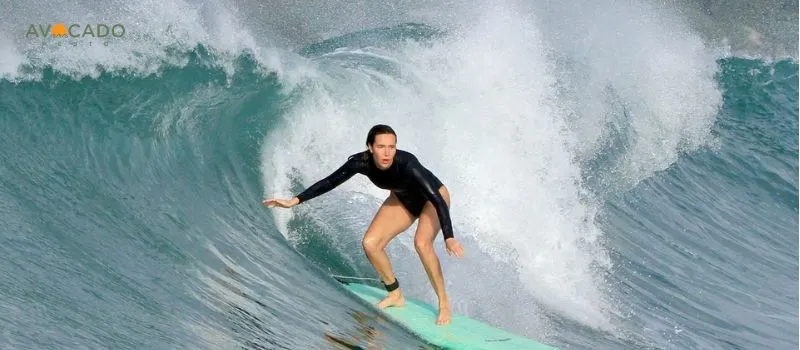
When most people picture surfing in Bali, they imagine fast, hollow, adrenaline-pumping waves breaking over sharp coral reefs. While that is certainly true for places like Uluwatu or Padang Padang, there is a hidden gem on the island’s southwest coast that breaks the mold entirely.
Medewi is a peaceful, palm-fringed village that offers a completely different kind of surfing experience. It is home to Bali’s most famous, longest, and most approachable left-hand wave. Instead of a frantic, high-consequence drop, Medewi provides a rolling, mechanical, and canvas-like wave face that can peel for hundreds of meters.
However, because Medewi relies on a complex mix of river runoff, a unique rock-and-boulder seafloor, and specific wind angles, understanding its raw mechanics is crucial if you want to score the ride of your life.
1. The Anatomy of Medewi Point: The Epic Left
The undisputed crown jewel of the region is Medewi Point. It is highly classified as a classic, left-hand cobblestone point break.
Unlike a reef break formed by living coral, Medewi’s bathymetry (seafloor topography) consists of thousands of smooth, river-worn volcanic boulders and stones that have settled at the mouth of a local river. Over thousands of years, these stones have mapped out a perfectly slanted underwater gradient that coaxes incoming ocean swells into structured, peeling lefts.
Wave Characteristics
- The Shape: Soft, crumbling, and rolling. It is rarely a hollow barrel. Instead, it creates a long, fat shoulder that is highly workable.
- The Length: On an optimal day with a solid swell, you can ride a single wave for over 300 to 500 meters, carving and cruising for nearly a minute straight.
- The Vibe: Because the wave crumbles gradually rather than pitching violently, it is an absolute paradise for longboarders, fish enthusiasts, mid-lengths, and intermediate shortboarders looking to hone their rail-to-rail transitions.
2. The Alternates: Medewi River Mouth and Yeh Sumbul
While the Point gets all the glory, the surrounding area features distinct wave types that offer excellent alternatives depending on the daily conditions.
Medewi River Mouth
Directly adjacent to the point sits the river mouth peak. Heavy tropical rains regularly flush sand down the river, mixing with the cobblestones to create temporary sandbars. This spot can produce shorter, faster, and punchier right-and-left A-frame peaks. It is a fantastic option when the main point is small or overly crowded, though it is highly sensitive to recent storm runoff.
Yeh Sumbul (The Beachie)
Just across the bay lies Yeh Sumbul, a classic exposed beach break. Shifting from boulders to a predominantly sandy bottom with scattered rocks, Yeh Sumbul offers playful, forgiving peaks that break in both directions. It is highly accommodating to beginners and works efficiently on a lower tide when the main point becomes too shallow and hazardous.
3. The Formula for Perfect Conditions
To experience Medewi at its absolute finest, you need a few key oceanographic elements to align. When checking the local surf forecast, keep these magic numbers in mind:
Swell Direction and Size: South to Southwest (S-SW)
Medewi requires a decent amount of energy to wrap into its deep bay. It thrives on long-period groundswells tracking from the South-Southwest.
Because of its gradual underwater slope, Medewi handles size remarkably well. While it can become a fun longboard wave at 2 to 3 feet, it truly comes alive when the swell registers at 4 to 6 feet (head-high to overhead). If the swell grows massive (double-overhead+), the sets will break further out in deeper water, sometimes turning into one long, slow-moving “mush-burger” that requires a high-volume board to keep momentum.
Wind Direction: North to Northeast (N-NE)
The ultimate wind for Medewi is a light breeze blowing from the North or Northeast. Because the point tracks out to the southwest, a N-NE wind blows directly offshore, grooming the wave faces into smooth, glassy canvases.
- Dry Season Trade Winds: From May to August, the strong Southeast (SE) trade winds kick up by mid-morning. This creates a cross-onshore chop. To beat this, surfers practice “Dawn Patrol”—hitting the lineup at 6:00 AM to enjoy the glassy morning windows before the trade winds take over.
- Wet Season Winds: Conversely, during the wet season (November to March), the Northwest Monsoon brings favorable offshore wind angles to Medewi, often producing incredibly clean, uncrowded winter conditions.
4. The Tide: Medewi’s Ultimate Gatekeeper
You can have a perfect 6-foot SSW swell and a light offshore wind, but if you miscalculate the tide, your session can quickly turn hazardous. Medewi is highly sensitive to tidal movements due to its boulder bottom.
High Tide: Soft and Deeper
A high tide creates a deep, safe cushion of water over the treacherous rocks. The wave becomes exceptionally soft, slow, and forgiving. This is the prime time for heavy longboards and foamies. However, if the tide is too full and the swell is small, the wave can lose its structural integrity and struggle to break cleanly.
Mid Tide: The Sweet Spot
Ask any local guide, and they will tell you that a medium, incoming tide is the golden hour. At mid tide, there is enough water depth to cover the boulders safely, yet the wave still interacts perfectly with the cobblestone ledge, forming a cleanly tapering, long-peeling wall of water.
Low Tide: Fast and Shallow
At low tide, the water drains completely from the point, exposing a hazardous minefield of sharp, barnacle-covered rocks and sea urchins. The wave becomes faster, section-heavy, and highly technical. Entering and exiting the water requires a meticulous, barefoot tightrope walk or a sturdy pair of reef booties. Beginners should strictly avoid the point during a low tide.
Ideal Surf Matrix for Medewi
| Wave Location | Bottom Type | Best Swell | Best Wind | Best Tide | Skill Level |
| Medewi Point | Cobblestone / Rock | 4 – 6ft SSW | N – NE (Offshore) | Mid to High | Intermediate to Advanced |
| River Mouth | Rock & Shifting Sand | 3 – 5ft S – SSW | Light N | Mid Tide | Intermediate |
| Yeh Sumbul | Sand & Scattered Rock | 2 – 4ft S | NW to N | Low to Mid | Beginner to Intermediate |
Recharge and Refuel at Avocado Resto
Navigating a 300-meter-long wave is exhilarating, but the long paddle back out against the point current will test your endurance. By the time you step out of the water, navigating the final stretch of shoreline rocks, your body will be screaming for replenishment.
That is where Avocado Resto comes in. Located just minutes away from the main surf break, our kitchen is dedicated to refueling surfers with fresh, nutrient-dense, and highly satisfying meals.
To combat muscle fatigue and restore your energy levels, we focus on wholesome ingredients loaded with healthy fats, clean proteins, and complex carbohydrates. Whether you are craving our signature Avocado Toast after an early morning glass session, a cold-pressed juice to rehydrate, or a comforting bowl of local Indonesian fare to warm up after a rainy wet-season surf, Avocado Resto is your ultimate post-surf sanctuary.
Drop by, check the tide charts hanging on our walls, grab a nourishing bite, and swap stories of your longest rides with our vibrant community of ocean lovers.
Avocado Resto
📍 Jl. Widuri Simpang Tiga, Medewi, Jembrana, Bali
📞 081338546264
✉️ eat@avocadoresto.com
🌐 www.avocadoresto.com