
Last updated: July 2026 · By Avocado Resto Team
The forecast said clean. The sky said otherwise. Your 6 AM alarm promised offshore winds and glassy sets. By 9 AM the horizon turned grey, and by 9:30 the rain was drumming on your rented roof like someone testing every single nail.
You are now standing under a restaurant awning with a board bag that weighs double what it did this morning, a poncho that redirected the water straight down your neck, and three hours of unplanned time. The lineup is flat white. The swell is still there underneath, but the surface looks like someone is shaking a carpet at it.
This is a normal Wednesday in West Bali.
This guide covers the full reality of finding an indoor restaurant Medewi rainy day — what the options actually look like, how Balinese architecture handles rain, what to order for your body’s real needs when you are wet and cold, how to manage a scooter in tropical downpours, what to do with your gear, and how to read the weather so you know whether this storm will pass in thirty minutes or settle in for the afternoon.
This is not a list of pretty cafes. This is a manual for the rainy day you did not plan for.
Understanding West Bali’s Rain Patterns
To navigate rainy-day dining well, you first need to understand what kind of rain you are dealing with. West Bali has distinct rain types, and each demands a different strategy.
Two Seasons, Three Rain Types
Bali’s climate follows a simple monsoon cycle, but West Bali’s position on the island’s western tip creates a local microclimate worth understanding.
| Season | Months | Rain pattern | Impact on dining |
|---|---|---|---|
| Dry season | April to October | Short afternoon squalls, 30–90 minutes, intense but fast-clearing | Wait it out with one meal; surf usually cleans up after |
| Wet season | November to March | Prolonged rain, multiple hours, sometimes all-day drizzle | Plan for full indoor time; book ahead |
| Transition months | March–April, October–November | Unpredictable mix; clear mornings with sudden afternoon downpours | Always have a Plan B; check sky at breakfast |
Squalls are the most common rain event in the dry season. They roll in fast — you will see the curtain of rain approaching from the sea before it hits. They dump hard for thirty minutes to an hour, then clear just as suddenly, leaving the air cooler and the offshore wind stronger. These are easy to manage: find cover, order something warm, and by the time your coffee is finished the sky is often blue again.
Monsoon troughs are different. During the wet season, rain can settle in for four to six hours with no break. The sky stays uniformly grey. The road stays wet. The surf becomes a washing machine. These days require a different approach — not a quick wait but a complete pivot to indoor activities.
Why does Medewi get sudden rain even in July? The answer lies in the terrain. West Bali’s coastal plain meets the foothills of the Bali Barat mountains. Warm air from the Indian Ocean rises when it hits the hills, cools, and condenses into clouds. This orographic effect means afternoon cloud buildup is normal even during the dry season. It is not a sign of bad weather — it is just the island breathing.
The practical implication: if you are planning a full day of surfing in Medewi, assume you will lose one session to rain, especially between 1 PM and 4 PM. Plan your meal timing around that window.
Indoor vs Covered Outdoor — The West Bali Building Reality
Travellers from temperate climates often search for “indoor dining” and picture a fully sealed room with air conditioning and four walls. That expectation causes frustration in West Bali, where restaurant architecture follows a different logic.
Why Restaurants Are Built Open-Air
Most Medewi restaurants are open-sided by design, not by accident. Balinese architecture prioritises natural ventilation over climate control for three reasons:
- Temperature. Even on a rainy day, temperatures in Medewi stay around 26–30°C. Fully enclosed spaces become stuffy without mechanical cooling. Open sides let the breeze through, which most diners prefer 80 per cent of the time.
- Cost and reliability. Reliable air conditioning requires sealed rooms, consistent power, and high electricity bills — expenses that raise menu prices. Many village restaurants choose to keep prices accessible by working with the climate rather than fighting it.
- Cultural tradition. Traditional Balinese compounds are built as a series of open pavilions called bale — roofed structures with partial or no walls. Modern restaurants in Medewi inherit this logic, adapting it with higher roofs and tile floors.
Understanding this helps you adjust expectations. The goal is not to find a sealed box. The goal is to find the driest seat in an open-air structure — and that is a skill you can learn.
How to Read a Roof
Before you sit down during rain, train yourself to scan these four variables:
1. Roof overhang. A roof that extends two metres past the dining area provides a dry zone even when rain comes in at an angle. A roof that ends exactly at the table edge leaves the seats vulnerable to wind-driven spray.
2. Wind direction. Most Medewi restaurants have an open side facing the ocean (west or south-west) and a more protected side facing land. On a rainy day, the windward side gets wet regardless of how good the roof is. Ask staff which side the wind is coming from and sit on the opposite edge.
3. Floor material and drainage. Tile floors with proper drainage stay usable in rain. Wooden decks become slippery when wet. Dirt or gravel floors turn muddy. Scan the floor before you sit — if you see puddles forming in the area, those seats will not stay dry.
4. Temporary weather adaptations. Some restaurants in Medewi deploy plastic roll-down curtains or bamboo blinds when rain hits. These are effective against wind-driven rain but reduce airflow. On a humid rainy day, the space can become steamy quickly. Decide which trade-off you prefer: dry but warm, or breezy but potentially damp.
| Seating type | What it means structurally | Rain performance | Best used for |
|---|---|---|---|
| Fully enclosed indoor | Walls + roof + door; limited air exchange | Excellent in all rain conditions | Prolonged storms; travellers needing dry storage for gear |
| Covered open-air (wide roof) | Large roof overhang, open sides | Good for light-to-moderate rain; wind-driven rain still hits edges | Quick squalls; short meals; watching the rain fall |
| Covered open-air (narrow roof) | Roof just covers the table, minimal overhang | Vulnerable to angle rain; okay in vertical drizzle | Dry-day seating only; move when rain starts |
| Umbrella tables | Freestanding market umbrella over a single table | Weak in any real rain; umbrella provides false confidence | Avoid entirely during rain |
| Temporary weather walls | Roll-down plastic or bamboo blinds added during rain | Good when deployed; variable quality; some let water through seams | Ask “are the sides down?” — if not yet, request it |
Red Flags to Identify in the First Five Seconds
- Umbrellas over tables — these provide overhead cover in light sun, not rain protection
- Tables at the outermost edge of a roof with no wall behind them
- Puddles already forming on the floor (not from wet shoes, from roof gaps)
- Electrical outlets near open windows that could get splashed
- Staff members standing in a specific corner while the rest of the room is empty — that is the dry spot
The Science of Ordering in the Rain
Most rainy-day food advice is generic: “order something warm.” But there is actual physiology and food science behind why certain meals work better when you are wet, cold, and depleted from an aborted surf session.
Body Temperature and Digestion
When you sit down after a wet scooter ride or paddling in through rain, your body has been working to maintain core temperature at 37°C. It does this by constricting blood vessels in your extremities — your fingers, toes, and skin — shunting warm blood toward your internal organs. This is why your hands look pale and your feet feel numb.
Eating cold food forces your body to spend additional energy warming that food to body temperature before digestion can properly begin. A cold salad can drop your core temperature by a fraction of a degree, which your body compensates for by burning extra calories. Warm food, by contrast, enters your stomach at a temperature closer to your core, reducing this metabolic overhead.
The practical takeaway: if you are already cold from rain, your body needs help with temperature regulation, not additional work. Warm food and hot drinks are not just comforting — they are physiologically efficient.
Fluid and Electrolyte Balance in Tropical Rain
This is counterintuitive but important: you can get dehydrated while being rained on. Sitting in humid air with wet clothing reduces your body’s ability to cool itself through sweat evaporation, which causes you to sweat more to achieve the same cooling effect. You are losing water even as rain runs down your face.
Hot tea, ginger drink, and electrolyte-rich soups serve a dual purpose — they warm you and replenish fluids. Straight coffee is diuretic, so balance it with water or tea.
Rainy Day Menu Choices — A Deeper Breakdown
| Mood | Physiological state | Order direction | Why this works |
|---|---|---|---|
| Wet scooter arrival | Peripheral vasoconstriction, mild dehydration, adrenaline from wet ride | Hot drink first + soup or broth | Warms core, rehydrates, calms nervous system before ordering main |
| Soaked from sudden squall while paddling | Cold exposure, muscle fatigue, possible mild saltwater dehydration | Hot sweet drink + carbohydrate-heavy meal (rice, pasta, toast) | Sugar raises blood glucose quickly; carbs replenish muscle glycogen |
| Family with kids stuck indoors | Restless children, hungry adults, everyone bored | Safe kid plates + comforting adult mains + shared snacks | Order in waves — kids eat first, adults choose calmly after |
| Long rainy afternoon with laptop | Sitting still in humidity, mild mental fatigue | Coffee + sustained energy meal (protein + complex carbs) | Avoid sugar crash; protein maintains focus through afternoon hours |
| Early morning rain killing dawn patrol | Woke up early for nothing, tired, disappointed | Full breakfast — eggs, toast, fruit, hot drink | Long breakfast as event; resets the day mentally |
| Evening storm while already warm and dry | Comfortable, not cold, but trapped indoors | Hot drink + dessert or light meal | Enjoy the ambiance; no need for heavy warming food |
What to Avoid
Cold salads and smoothie bowls on a wet day feel virtuous but work against your body’s immediate needs. Iced drinks constrict throat capillaries and slow the warming process. If you want fruit, order it sliced at room temperature — not chilled. Heavy fried foods are fine in moderation but require more digestive energy, which diverts blood flow away from your cold extremities.
The best rainy day meal in Medewi follows a simple formula: hot drink first, warm main second, optional sweet treat third. Do not reverse the order. The hot drink warms your core and tells your nervous system that you are safe and dry. Everything after that is bonus.
Rainy Day Logistics — The Full Guide
The food is only half the equation. How you handle the wet logistics determines whether the meal is relaxing or stressful.
Scooter in the Rain — Extended Safety Guide
Most Medewi visitors ride scooters. Rain transforms a familiar ride into a genuinely hazardous activity. Here is what changes:
Tyre grip. Wet asphalt reduces friction by roughly 30 to 40 per cent. On painted road markings — the white lines at intersections, the centre dividers — grip drops by 60 per cent or more. A scooter that stops comfortably from 40 km/h in ten metres of dry road needs at least fifteen metres in the wet, and up to twenty on painted surfaces. Adjust your following distance accordingly.
Cornering. Leaning through a turn on wet pavement is different. Your tyres have less lateral grip. Reduce cornering speed by at least half. Straighten the bike before the turn, not during it. Avoid braking mid-corner — that is how fronts wash out.
Visibility. Rain on a visor creates distortion. Rain on sunglasses is worse. A clear visor or transparent goggles are essential for wet-weather riding. Keep your headlight on at all times — not to see, but to be seen. Grey rain light makes scooters nearly invisible to cars.
Standing water. Never ride through water deeper than your scooter’s footboard. Hidden potholes, open drainage grates, and sudden drop-offs are common on Medewi’s village roads. If you cannot see the bottom, go around or turn back. A submerged pothole at low speed will bend a rim; at moderate speed it can throw you off.
Brakes after a wet ride. Drum brakes (common on rear wheels of rental scooters) lose significant stopping power when wet. After riding through rain, pump your brakes gently a few times before you need them — this uses friction heat to dry the brake surfaces.
Rain gear. A poncho keeps your torso dry but flaps in the wind and can catch cross-breezes from passing trucks. A rain jacket worn over a light shirt is more stable at speed. Waterproof shoe covers or sandals that drain fast matter more than people realise — wet feet for hours is a fast route to misery even under a dry roof.
Gear Management at the Restaurant
A surfboard, wetsuit, and backpack full of wet electronics create their own set of problems. Here is how to handle each:
Board bag. Ask staff where to store it before you sit down. A wet board bag dripping on a tile floor creates a slip hazard. Most Medewi restaurants have a corner or a storage rack for boards. If they do not, place your bag against a wall away from walking paths, preferably on a surface that drains (tile or concrete, not carpet or wood).
Wetsuit. Do not drape a wet wetsuit over a restaurant chair. The neoprene will soak the seat cushion, and the next diner will sit in a puddle. Ask for a hook or hang it over your board bag. If you must drape it somewhere, use a rail or beam — not furniture.
Electronics. Assume your backpack is not waterproof even if it claims to be. Zipper seams leak under sustained rain. Keep your phone, power bank, and any camera gear in a separate dry bag or zip-lock pouch inside your backpack. If you are ordering with a phone, wipe it down first — wet screens register phantom touches.
Helmet. A wet helmet interior will not dry in time for your ride home. Remove the lining if possible and wring it out. Place the helmet upside-down on a dry surface so water drains out of the padding rather than pooling inside it.
The Sudden Rush Phenomenon
When rain hits Medewi, something predictable happens: every surfer within two kilometres heads for the same three or four restaurants. This creates a spike in orders that kitchens did not anticipate. Understanding this rush helps you navigate it better.
- Order drinks immediately. The kitchen is about to get slammed. A drink order is simple, gives the kitchen time to process, and ensures you have something in front of you while you wait.
- Decide before the server reaches you. Nothing slows a rainy-day service like someone ordering “uh, give me a minute” while holding up six other wet customers behind them.
- Be patient with timing. If fifteen people arrived in the same five-minute window, your food will take longer than usual. Factor this into your mood and plan accordingly.
Reading the Weather — Will This Pass or Settle?
A practical skill for rainy-day dining: knowing whether the rain will clear in time for another surf session, or whether you should surrender to the idea of a land day.
| Sky sign | Likely outcome | Decision |
|---|---|---|
| Dark clouds from the sea, moving fast, blue sky visible behind them | Passing squall — 30–60 minutes | Order one hot drink and wait; surf likely clean after |
| Uniform grey, no defined edge, no blue visible anywhere | Settled rain — 2+ hours | Order full meal; pivot to land activities |
| Light drizzle with occasional heavy bursts, wind shifting | Unstable; could go either way | Stay flexible; order in waves — light snack first, main later |
| Rain starting after 3 PM in dry season | Likely clears by sunset | Wait it out with early dinner; late surf possible |
| Thunder or lightning | Stay out of water for 30 min after last thunder | Do not rush; lightning risk is real even miles away |
Respect the lightning rule. If you hear thunder, the lightning is close enough to be dangerous. Bali’s beaches are exposed. A lightning strike on flat water travels a long way. The standard safety guideline is to wait 30 minutes after the last thunderclap before re-entering the water. Use that time to eat properly.
What to Do on a Full Rain Day — Beyond Eating
A single meal can fill one to two hours of a rainy afternoon. If the rain has settled in for the day, you need a broader strategy. Here is how to structure a full rainy day in Medewi without feeling like you wasted it.
Morning Washout (07:00–10:00)
Dawn patrol is cancelled. Go back to sleep until 8 AM, then have the longest breakfast of your trip. Eggs, toast, fruit, multiple coffees. Read something that is not a surf forecast. Check the radar. By the time you finish, you will either see clearing skies or know that today is a land day.
Midday Rain (10:00–14:00)
This is the hardest window for surfers because the frustration peaks. The solution is to make a plan that involves food, rest, and a small productive task. Order a main meal. Charge everything you own. Write that email you have been putting off. If you are travelling with people, have the conversation you normally skip because you are rushing to the water.
Afternoon Break (14:00–16:00)
If the rain is still going, order a hot drink and a small snack. Check the surf report every 30 minutes. Watch the sky. If you see a light patch on the horizon — a “sucker hole” in surfer terms — the squall is breaking up.
Early Dinner (17:00–18:30)
Whether the rain cleared or not, early dinner in Medewi is a good move. The evening wind often cleans up the surface, and a post-rain sunset in West Bali is genuinely spectacular when it happens. Rain-washed air has fewer particles, which means clearer light and richer colours.
Evening (18:30 onward)
If the rain stopped, the evening session might be clean. Offshore wind frequently follows a passing storm — better waves, fewer people. If the rain continued, accept the land day gracefully and plan a better surf session tomorrow.
Avocado Resto on a Rainy Day — What to Expect
Avocado Resto is open 07:00 to 22:00 every day. That span covers all three rain windows — the morning washout, the afternoon squall, and the evening storm that extends dinner into a long sit.
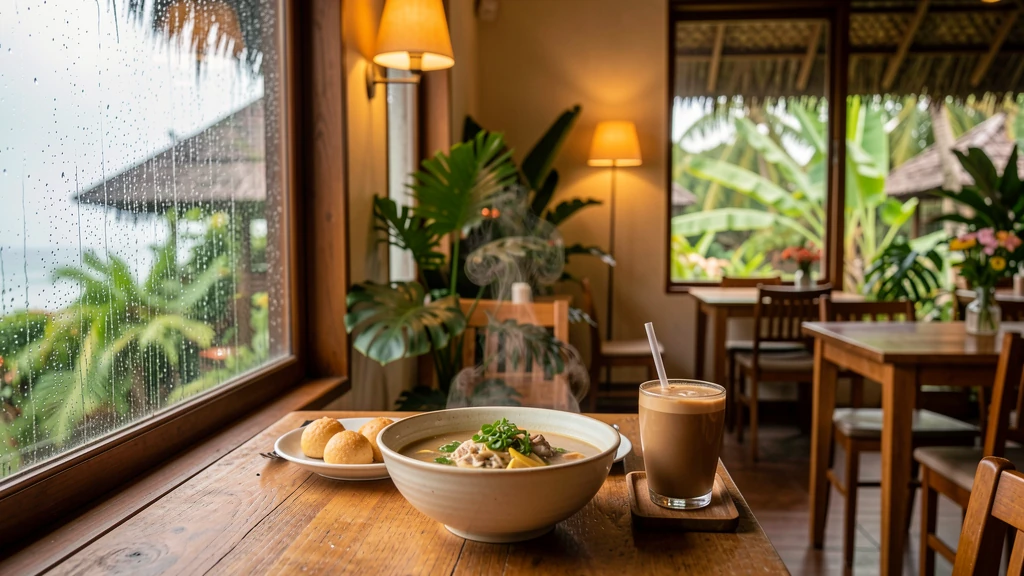
The seating reality. Avocado Resto has covered seating but is not a fully sealed indoor hall. The roof is solid. Some sections are more protected than others. When you arrive on a rainy day, ask staff for the driest available table. They know which corner stays dry in which wind direction. If you are planning ahead, send a message on WhatsApp and mention that you want covered seating — they can prepare accordingly.
The menu on a wet day. The all-day menu includes coffee, tea, ginger drink, grilled chicken, fish, pasta, rice bowls, eggs, toast, fruit, and smoothies. For rainy-day ordering: start with a hot drink. If you are cold, follow it with something warm from the grill section. If the rain is sticking around, order a full main and settle in. Browse the full menu before you come so you know your options.
Gear storage. The team is used to wet surfers walking in. Ask where to put your board bag and wet things. Do not leave a dripping wetsuit on a chair — staff can point you to a better spot.
Booking for rainy days. Walk-ins are welcome. If the rain is heavy and it is a weekend, message ahead or use the booking form to request a covered table. Rain crowds are real, and the best seats go first.
Note on honesty. We do not claim to have a fully air-conditioned indoor hall, free blankets, or board games. What we have is a dry roof, hot food, all-day hours, and a team that has seated hundreds of wet surfers. That is usually enough to turn a rainy day around.
FAQ
Does Medewi get rain in July?
Yes, though July is part of the dry season. West Bali’s coastal microclimate produces short, intense squalls even during dry months. These storms typically blow in from the Indian Ocean, dump heavy rain for 30 to 90 minutes, then clear just as fast.
Are fully indoor restaurants common in Medewi?
Fully sealed indoor restaurants are rare. Most venues follow Balinese open-air architecture. Ask for the most protected table rather than expecting a Western-style indoor dining room. Many places can deploy temporary weather walls when needed.
What should I order on a rainy day in Medewi?
Prioritise warm foods: soups, broths, hot tea or coffee, grilled proteins, pasta, rice-based mains. Avoid cold salads and raw dishes when you are already chilled. Carbohydrate-heavy comfort foods serve a practical purpose — they help restore energy your body spent trying to stay warm.
How do I ride a scooter safely in Bali rain?
Reduce speed by at least 30 per cent. Braking distance doubles on wet asphalt. Use both brakes gently — front brake provides most stopping power but grabbing it hard on a wet corner will slide the wheel. Keep your headlight on. Wear a clear visor or goggles. Avoid standing water deeper than your footboard.
Can I wait out a storm at a cafe for a long time?
Most restaurants are fine with it as long as you order fairly — a drink and a meal, or two drinks if the storm stretches. Avoid lingering on a single coffee during peak meal times. Confirm the kitchen’s last order time if the storm hits late.
How do I know when the surf will be good again after rain?
Check the Medewi surf report. Offshore wind often follows a passing squall, which can improve wave quality. Wait at least 30 minutes after heavy rain before paddling out, and watch for lightning before entering the water.
Should I book on rainy weekends?
Yes. A rainy weekend means covered tables fill fast. Book through the reservation form or WhatsApp and mention you want a protected table.
What if I get caught in rain while already on the road?
Pull over at the nearest restaurant or warung — do not keep riding through heavy rain, especially if lightning is present. Dry off under the awning, order a hot drink, and wait for the worst to pass. Medewi’s village road is narrow with limited shoulder space; riding in heavy downpour is genuinely dangerous.
Is it worth going out in light drizzle?
Light drizzle is common and usually safe to ride through if you have proper rain gear. Many restaurants in Medewi stay dry under their roofs during drizzle. The worst mistake is waiting for “perfectly dry” — in West Bali that can mean waiting all day.
Rain Is Part of the Deal
Rain in West Bali is not an anomaly. It is not bad luck. It is a regular feature of living in a tropical monsoon climate at the foot of a mountain range. The sooner you build it into your expectations, the less it will frustrate you.
A rainy day in Medewi means slower pace, longer meals, and a different kind of satisfaction — the feeling of being warm and dry while the weather does its thing around you. That is not a consolation prize. That is a different version of the same place, and it has its own appeal.
Choose your indoor restaurant Medewi rainy day carefully. Read the roof. Ask for the driest corner. Order hot first. Manage your gear. Check the surf report when the sky lightens. And if the rain outlasts your patience, order another coffee. The waves will still be there tomorrow.
Ready to find a dry table? Use the booking form with a note about covered seating or send a message on WhatsApp.
Written by Avocado Resto Team · Last updated: July 2026