
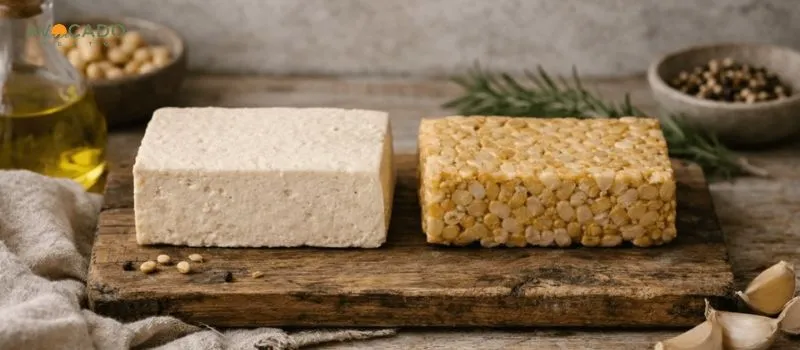
For anyone stepping into the vibrant world of plant-based eating, two names consistently dominate the menu: tofu and tempeh. To the uninitiated, they are often lumped together under the generic umbrella of “soy products” or dismissed as interchangeable meat alternatives.
If you stroll through a supermarket or take a seat at Avocado Resto, you will find both ingredients taking center stage in completely different culinary roles. That is because treating them as the same ingredient is like saying cheese and yogurt are identical simply because they both come from milk.
While both proteins trace their lineage back to the humble soybean, they are fundamentally distinct in their origins, creation methods, textures, and nutritional properties. To help you understand how these kitchen staples differ and which one you should order after your next West Bali adventure let’s break down the science and soul behind tempeh and tofu.
1. The Heritage: Ancient Java vs. Imperial China
The very first difference between these two foods lies in their historical roots.
- Tofu: Tofu is a culinary elder, with a history stretching back over 2,000 years to China’s Han Dynasty. Legend suggests it was discovered accidentally when a cook flavored a pot of boiling soy milk with unrefined sea salt, causing the liquid to curdle into delicate blocks. From China, it migrated across East Asia, becoming a cornerstone of Buddhist vegetarian cuisine.
- Tempeh (historically spelled Tempe): Tempeh is a fiercely proud Indonesian creation, originating on the island of Java centuries ago (with written records appearing in the early 1800s Javanese literary work, the Serat Centini). It holds a special place in global food history as one of the few major traditional soy foods that did not originate in China or Japan. It was discovered natively when cooked soybeans were wrapped in banana leaves, allowing wild, beneficial molds to naturally bind the beans together.
2. The Process: Curdling Milk vs. Fermenting the Whole Bean
The foundational difference in how they look, taste, and behave comes down to processing. Tofu is a byproduct of soy extract, while tempeh is a whole-food product.
How Tofu is Made
The process of making tofu is remarkably similar to dairy cheese production. Whole soybeans are soaked, ground, and boiled to create fresh soy milk. The solid fiber (called okara) is separated and strained out.
A natural coagulant typically calcium sulfate or magnesium chloride (nigari) is added to the hot milk to split it into curds and whey. The soft white curds are then gathered and pressed into solid blocks. Depending on how much moisture is pressed out, you get textures ranging from silky smooth to extra firm.
How Tempeh is Made
Tempeh takes a much less processed path, retaining the entirety of the soybean. Whole soybeans are soaked, dehulled, and lightly boiled. Once dried and cooled, the whole beans are inoculated with a specific, friendly fungus culture called Rhizopus oligosporus.
The beans are packed tightly into a clean environment (traditionally banana leaves, now often perforated bags) and left to ferment for 24 to 48 hours at a warm, tropical room temperature. As the fermentation progresses, a dense blanket of white mycelium (the root structure of the fungus) grows completely through the beans, knitting them tightly together into a firm, solid cake.
3. The Sensory Experience: Flavour and Texture
Because their production methods are completely opposite, eating tofu and tempeh offers entirely different culinary experiences.
TOFU
[Processed Soy Milk Curds]
• Soft, uniform, sponge-like
• Bland, neutral, absorbing
• Melts or crisps on the edge

TEMPEH
[Fermented Whole Soybeans]
• Dense, chewy, ultra-firm
• Nutty, earthy, mushroom-like
• Holds its structural bite- Tofu is a chameleon. In its raw form, it has a neutral flavor and a uniform, sponge-like texture. Because it is porous and mild, it acts as a flavor vehicle, absorbing whatever marinades, sauces, or spices you throw at it. It can be blended seamlessly into silky smoothies, fried until crispy on the edges, or baked into soft cubes.
- Tempeh is a main character. It refuses to hide in the background. Thanks to the whole beans and the fermentation process, tempeh is dense, highly textured, and robustly chewy. It possesses a complex flavor profile that is distinctly nutty, earthy, and slightly reminiscent of savory mushrooms. It holds its structural bite beautifully, making it ideal for grilling, crumbling into hearty sauces, or slicing thinly and frying into crisp strips.
4. The Nutritional Showdown
When it comes to human health, both options are nutritional heavyweights, providing complete plant-based proteins that contain all nine essential amino acids. However, their specific nutrient densities vary dramatically.
Why Tempeh Leads on Density, Fiber, and Gut Health
Because tempeh uses the entire soybean with nothing strained out, it is significantly more nutrient-dense than tofu. Gram for gram, tempeh contains roughly double the protein and significantly more dietary fiber than firm tofu.
Furthermore, the fermentation process acts as a form of pre-digestion. The beneficial culture breaks down the complex carbohydrates and anti-nutrients (like phytic acid) found naturally in soy. This makes tempeh highly digestible, reduces bloating, and unlocks the soybean’s vitamins and minerals, drastically increasing your body’s ability to absorb iron and zinc.
Why Tofu Wins on Calories and Calcium
Tofu is the lighter option. Because the solid fiber is removed during production, it contains less than half the calories and fat of tempeh, making it highly attractive to individuals tracking lower energy targets. Additionally, because most commercial tofu is set using calcium-based coagulants, it is an exceptional source of dietary calcium, making it a fantastic ally for bone health.
Head-to-Head Nutrition Matrix (per 100g)
| Nutrient | Tempeh (Whole & Fermented) | Firm Tofu (Pressed Curds) |
| Calories | ~165 – 195 kcal | ~75 – 95 kcal |
| Protein | ~19 – 20 grams | ~8 – 10 grams |
| Dietary Fiber | ~7 – 9 grams | ~0.3 – 2 grams |
| Carbohydrates | ~10 – 12 grams | ~2 – 3 grams |
| Calcium | Moderate | Very High (if calcium-set) |
| Digestion | Pre-digested via fermentation; gut-friendly prebiotics | Easy on the stomach but contains phytic acid |
Experience Both at Avocado Resto
At Avocado Resto, we celebrate the unique strengths of both ingredients. We don’t believe one is superior to the other; rather, we recognize that their individual textures and flavor profiles serve different culinary purposes.
Whether you have just spent the morning paddling out at Medewi’s famous left-hand point break or you are simply exploring the stunning scenery of West Bali, your body requires clean, restorative nourishment.
If you are craving a light, refreshing meal that takes on the bright, zesty notes of local Balinese lemongrass and chili, our carefully prepared tofu dishes offer a clean, satisfying protein hit. If you have a deep, ravenous appetite after a brutal paddle session against the current and need a dense, protein-packed, and fibrous meal to rebuild muscle fibers, our crispy, nutty Indonesian-style tempeh selections provide the ultimate recovery fuel.
Both tofu and tempeh prove that the humble soybean can be transformed into something extraordinary. Stop by Avocado Resto today, grab a seat, and let your taste buds explore the incredible difference for themselves!
Avocado Resto
📍 Jl. Widuri Simpang Tiga, Medewi, Jembrana, Bali
📞 081338546264
✉️ eat@avocadoresto.com
🌐 www.avocadoresto.com